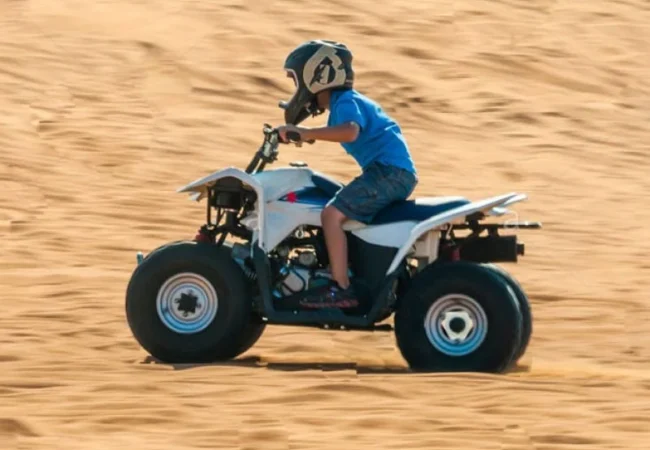
 AED 150
Yamaha 90cc
- Ages 9-12
- Track
- Supervised
Stays on its own flat, marked loop beside the main site, so the ground never gets more demanding than a straight line.
Book this ATV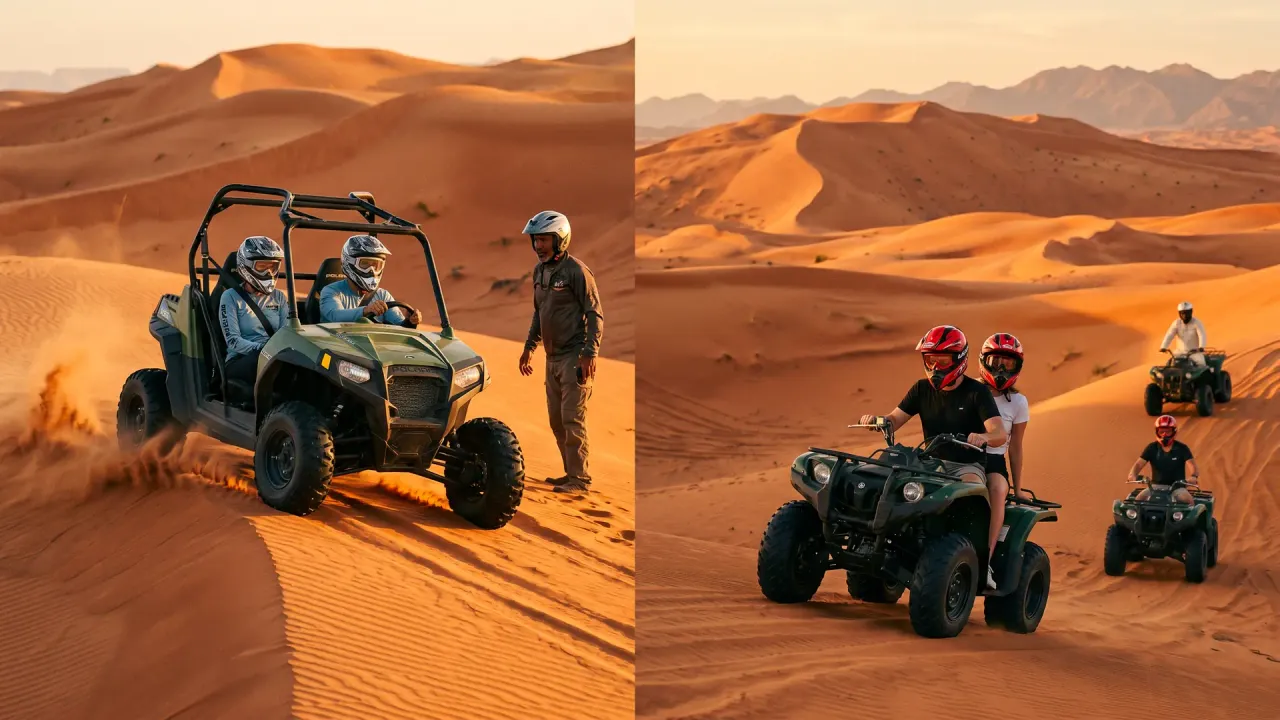
Al Lahbab's dunes are not one consistent surface. A bowl that grips firm on the way in can go loose and heavy three metres later, and a lead guide out front is reading that change before you ever reach it blind. ATV Dubai Desert runs eight Yamahas across that ground, from a supervised 90cc loop for children up to a screened Raptor 700cc, with your machine and your line both set by how the sand is actually behaving that day.
ATV Dubai Desert runs guided rides on the red dunes at Al Lahbab, roughly 45 minutes out to the city's southeast, where the sand turns from firm to loose across one short climb. The fleet holds eight Yamahas in four sizes. A supervised 90cc carries nine-to-twelve-year-olds for AED 150, first-time adult riders start on the 220cc for AED 200, and the 400cc, where most adults settle, runs AED 250. Clear the guide's check and the Raptor 700cc is yours, the biggest machine on site at AED 795.
If you book only one package, make it this one: a 4x4 dune-bashing leg, time on your own ATV, and dinner at the camp once the light fades, sold together as the Evening Desert Safari for AED 375 — the most-booked combination on this site. Secure online advance payment confirms your booking, support available 24/7.
Every machine is priced per rider — one person, one Yamaha, one fee — except the 400cc double, which seats two for a single price. What you pay tracks the machine, not the ground, though it's the tougher terrain that the bigger machines exist for.
| Machine | Suits | From |
|---|---|---|
| Yamaha 90cc | Ages 9 to 12, on the supervised loop, guardian close by. | AED 150 |
| Yamaha 220cc | Never ridden before. Light steering that forgives a soft patch. | AED 200 |
| Yamaha 400cc | What most tours are built around. Settled across mixed ground. | AED 250 |
| Yamaha 400cc double | Two riders sharing one machine, one fee. | AED 350 |
| Yamaha 400cc turbo | Same frame, more pull out of a climb. A common repeat pick. | AED 350 |
| Yamaha Grizzly 450cc | Heavier and planted. Suited to the longer routes. | AED 450 |
| Sports quad 625cc | Sharper handling that rewards riders with real hours logged. | AED 700 |
| Yamaha Raptor 700cc | Fastest machine on the fleet, handed over after a rider check. | AED 795 |
Every ride here is guide-led, so the machine matters less than the terrain does. Pick one you're comfortable on and the guide reads the ground, then adjusts the line to fit it.
AED 150Stays on its own flat, marked loop beside the main site, so the ground never gets more demanding than a straight line.
Book this ATV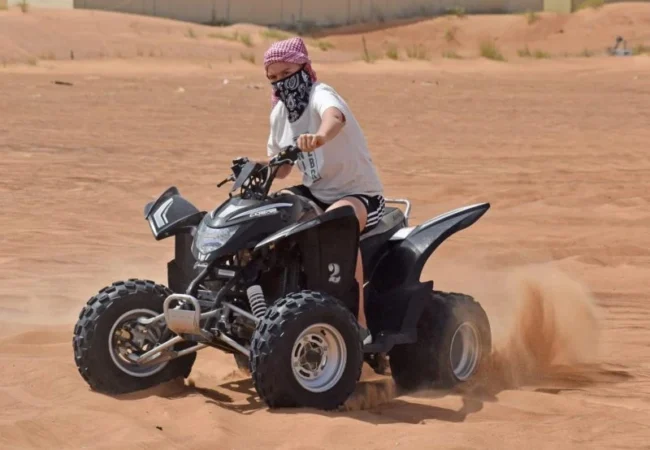 AED 200
Light enough that the terrain rarely fights back. Handed to first-timers so the ground teaches gently rather than all at once.
Book this ATV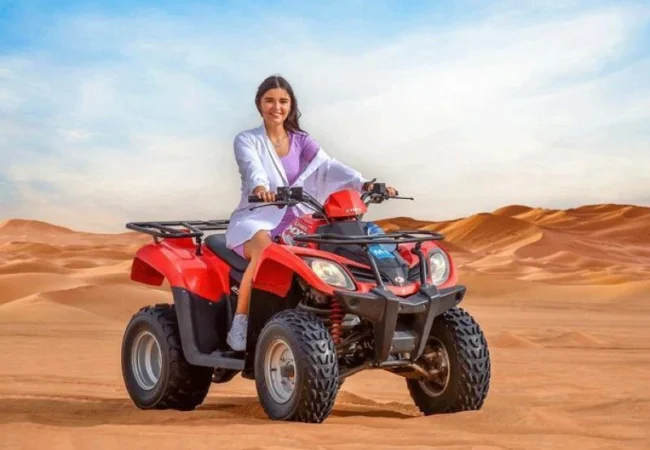 AED 250
Carries enough weight and pull to cross mixed ground without needing perfect technique. What the standard loop gets built around.
Book this ATV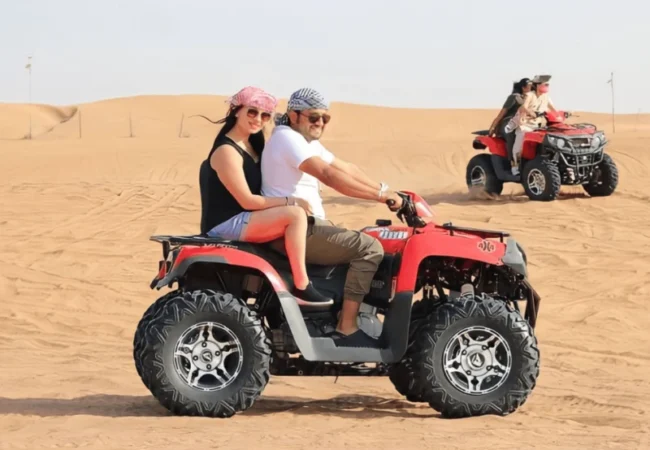 AED 350
One machine, two riders, a single line through the dunes chosen for whoever's on the bars.
Book this ATV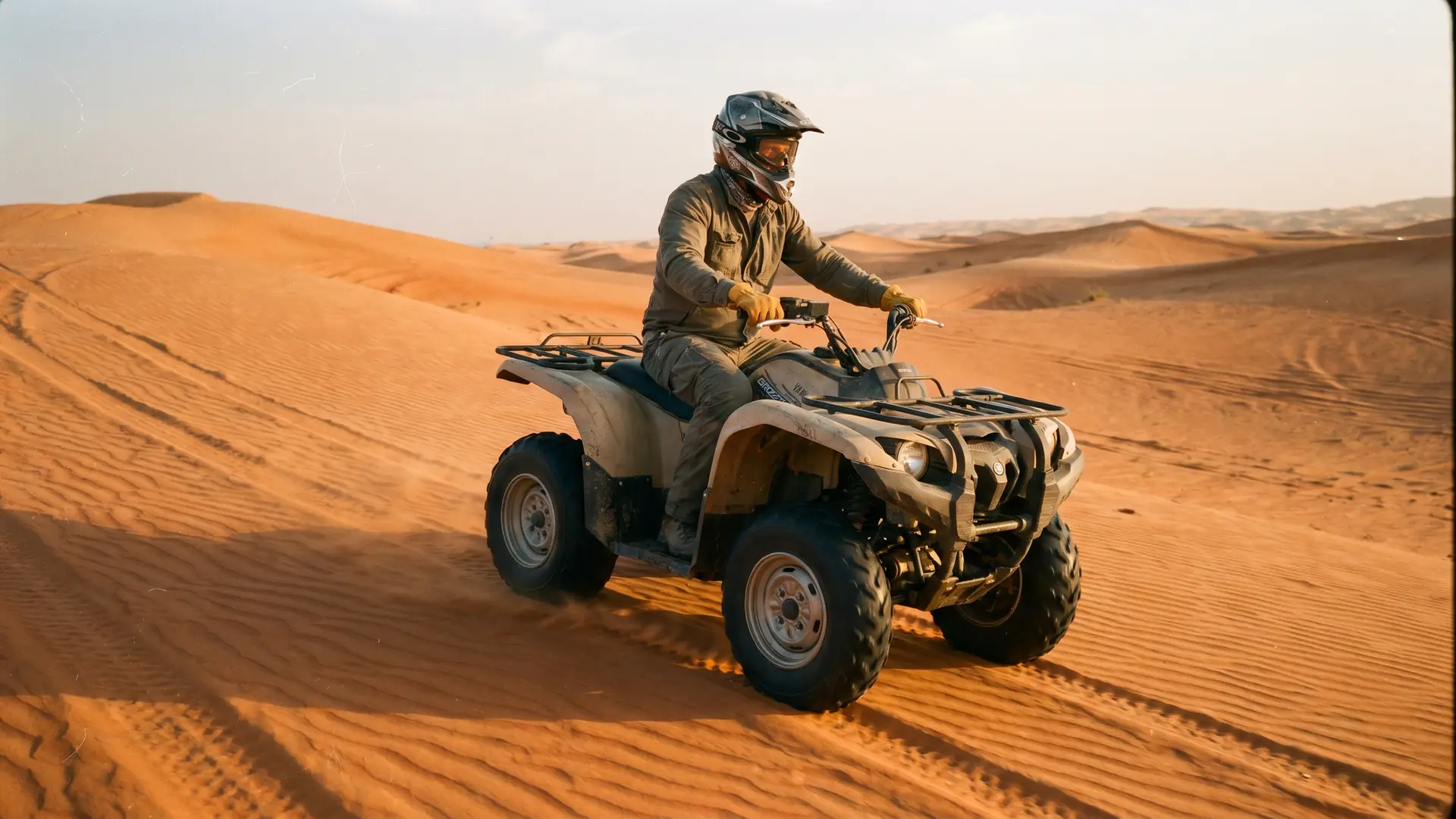 AED 350
Same frame as the standard 400, with enough extra pull to carry a soft climb without losing momentum halfway up.
Book this ATV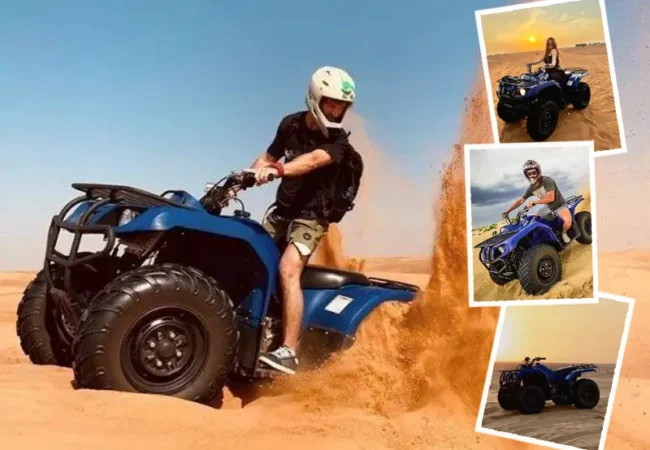 AED 450
Wider stance, more weight sitting over the wheels — noticeable on the longer routes, where the ground keeps changing under you.
Book this ATV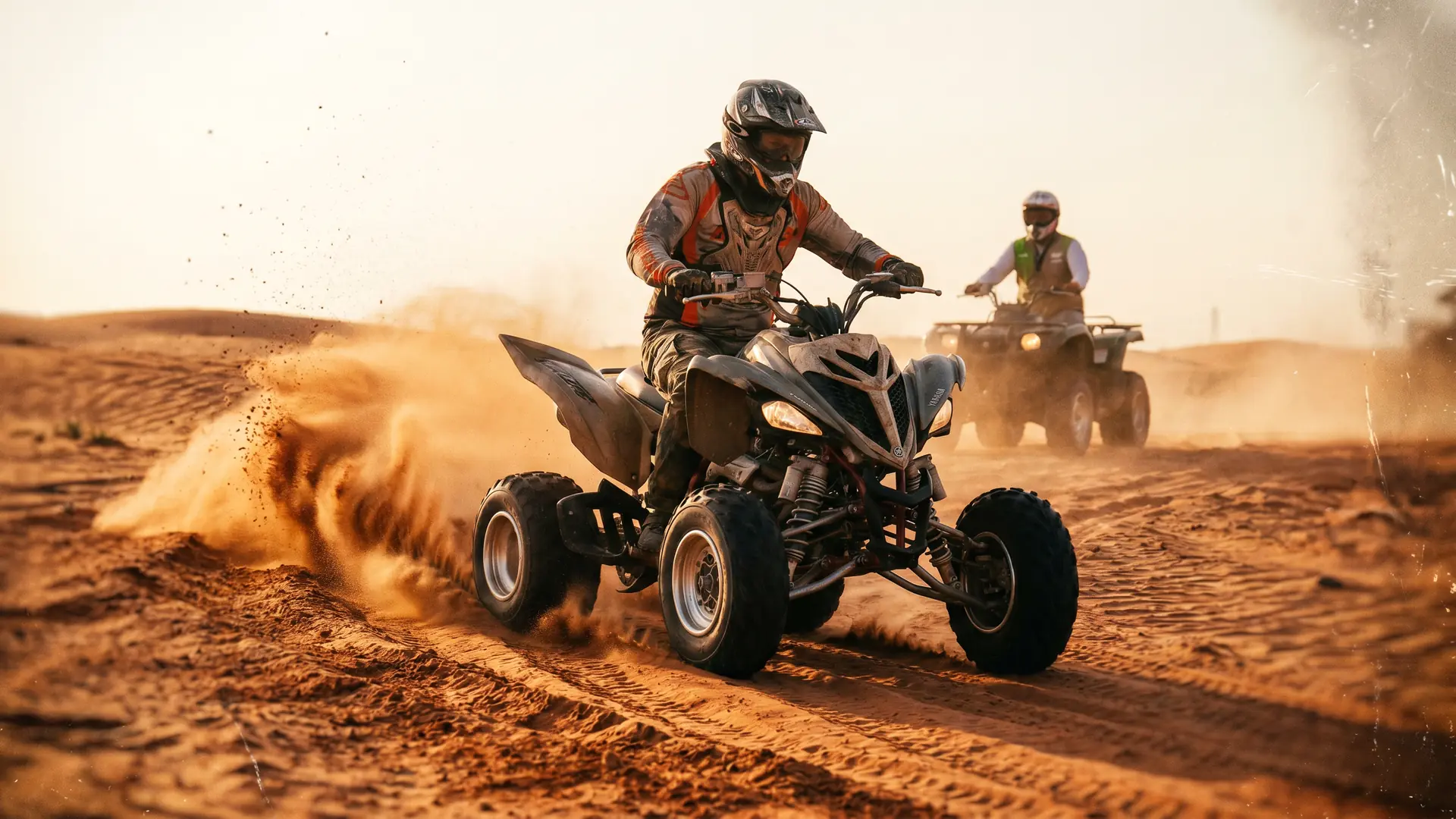 AED 700
Answers to a rider who shifts weight and stands on the pegs. Unforgiving if you sit still and let the ground decide.
Book this ATV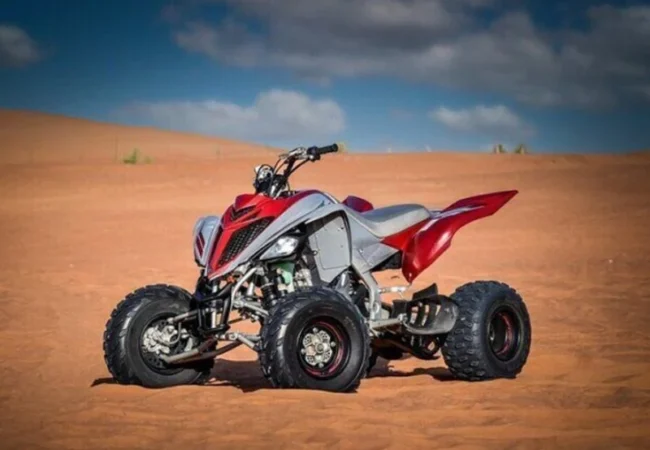 AED 795
Goes wherever the steepest terrain on the route allows. Cleared rider by rider, never handed over on request alone.
Book this ATVThe ride itself is an hour on changing ground; the drive out is forty-five minutes each way. Folding in the safari and dinner is what makes that drive worth it, which is why these combinations outsell a standalone session.
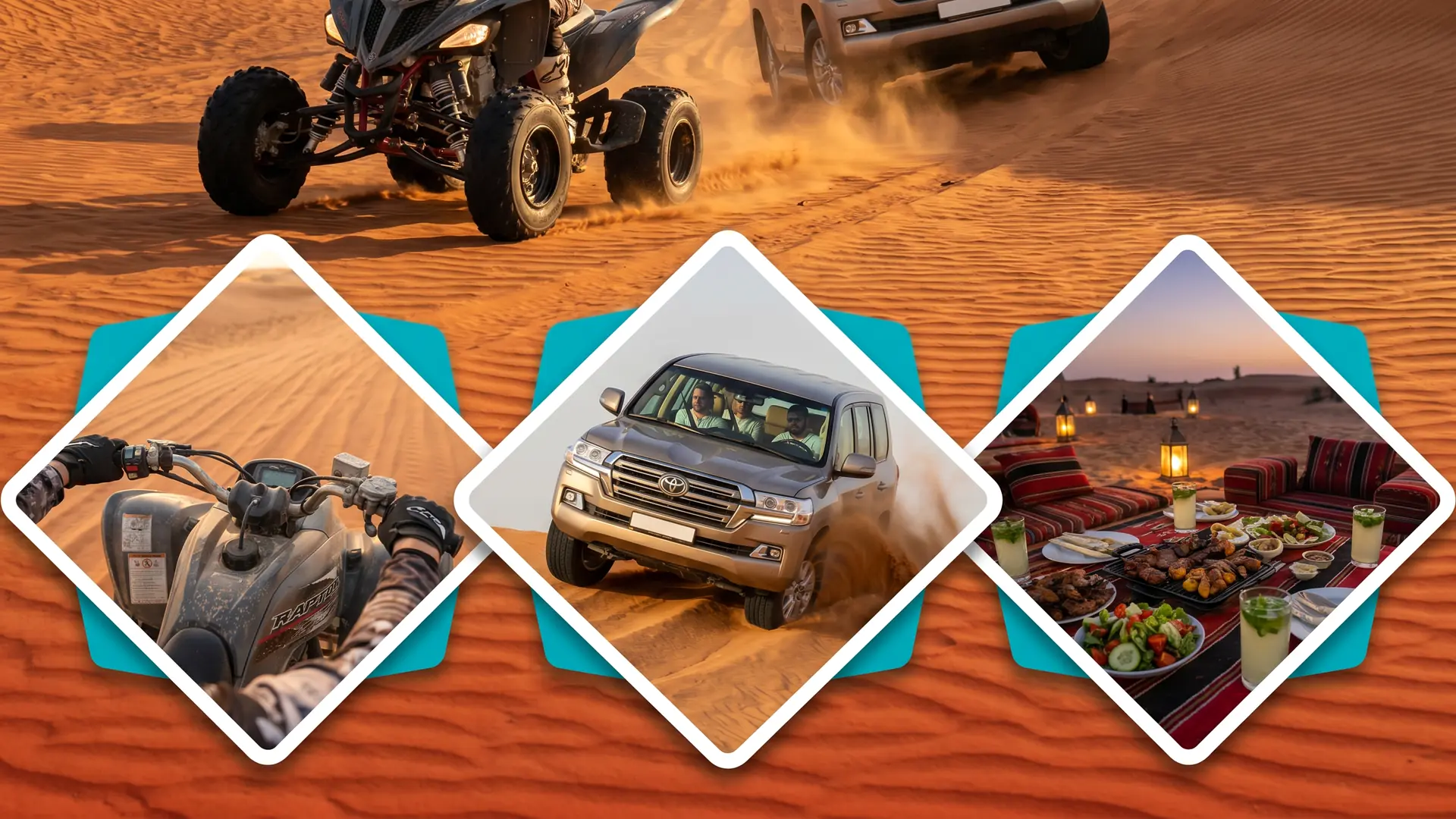 AED 375
A 4x4 dune-bashing leg first, then your own ATV session as the sand starts cooling and firming back up, sunset over the bowls, and the halal BBQ camp to close it out. The busiest booking on the list.
Book this tour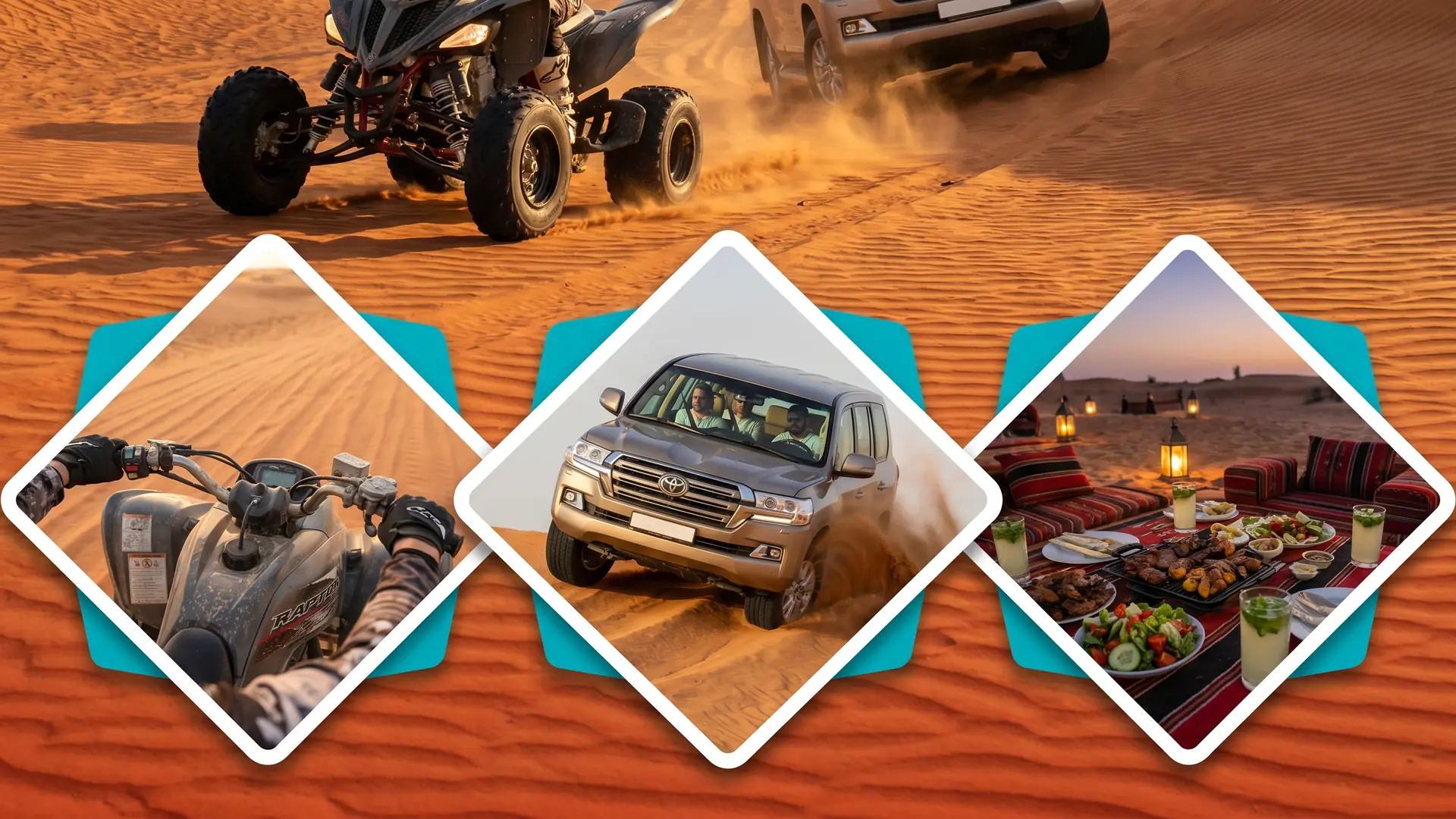 AED 290
Overnight cooling leaves the dune faces firmer than they'll be by afternoon — exactly the ground a first ride wants underneath it. Back in the city with the rest of your day untouched.
Book this tour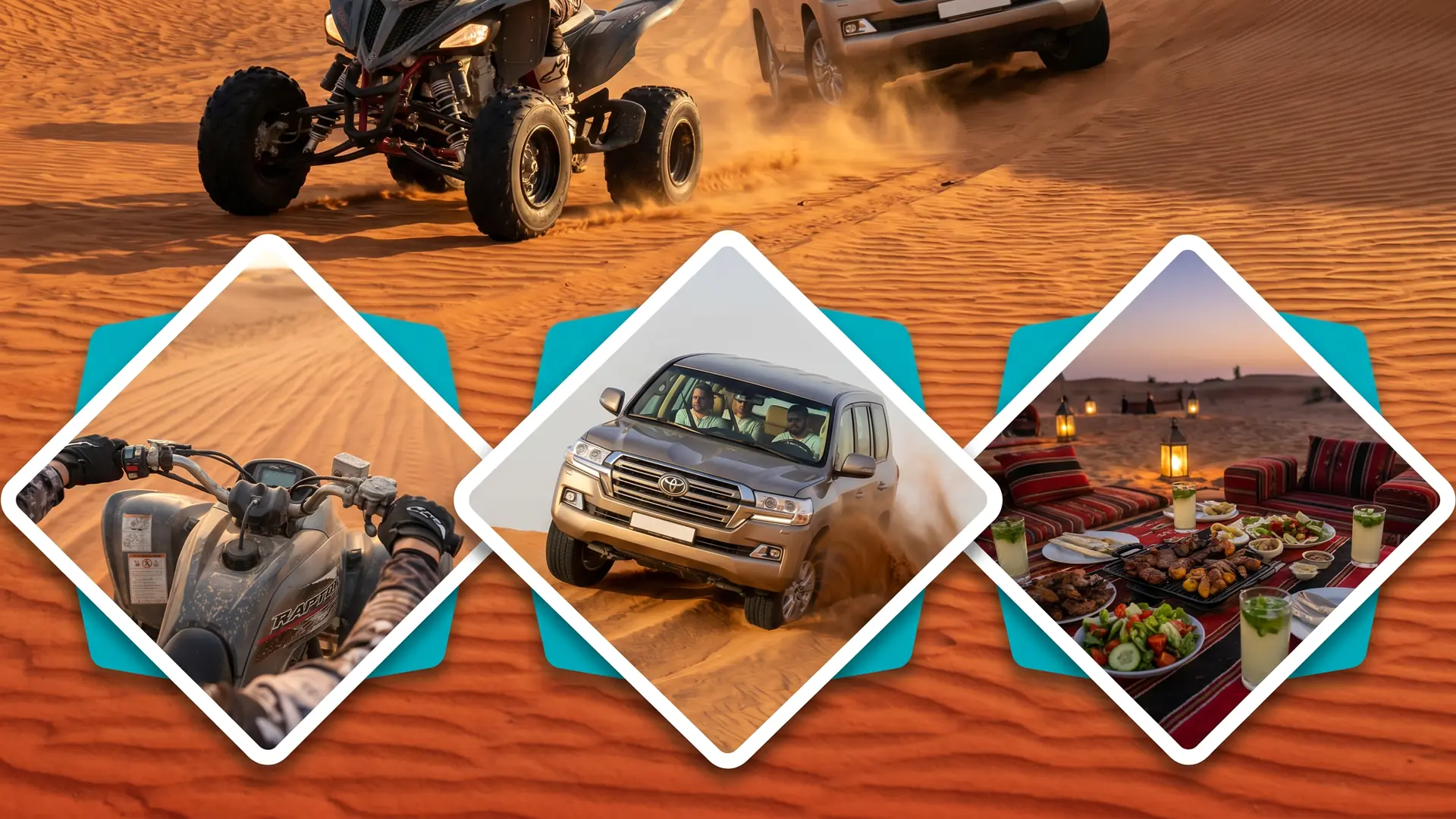 AED 700–1,300
Skips the 4x4 leg entirely, for anyone who'd rather not be thrown around a passenger seat. Keeps your own ride and the camp at the end. Price moves with the machine you choose.
Book this tour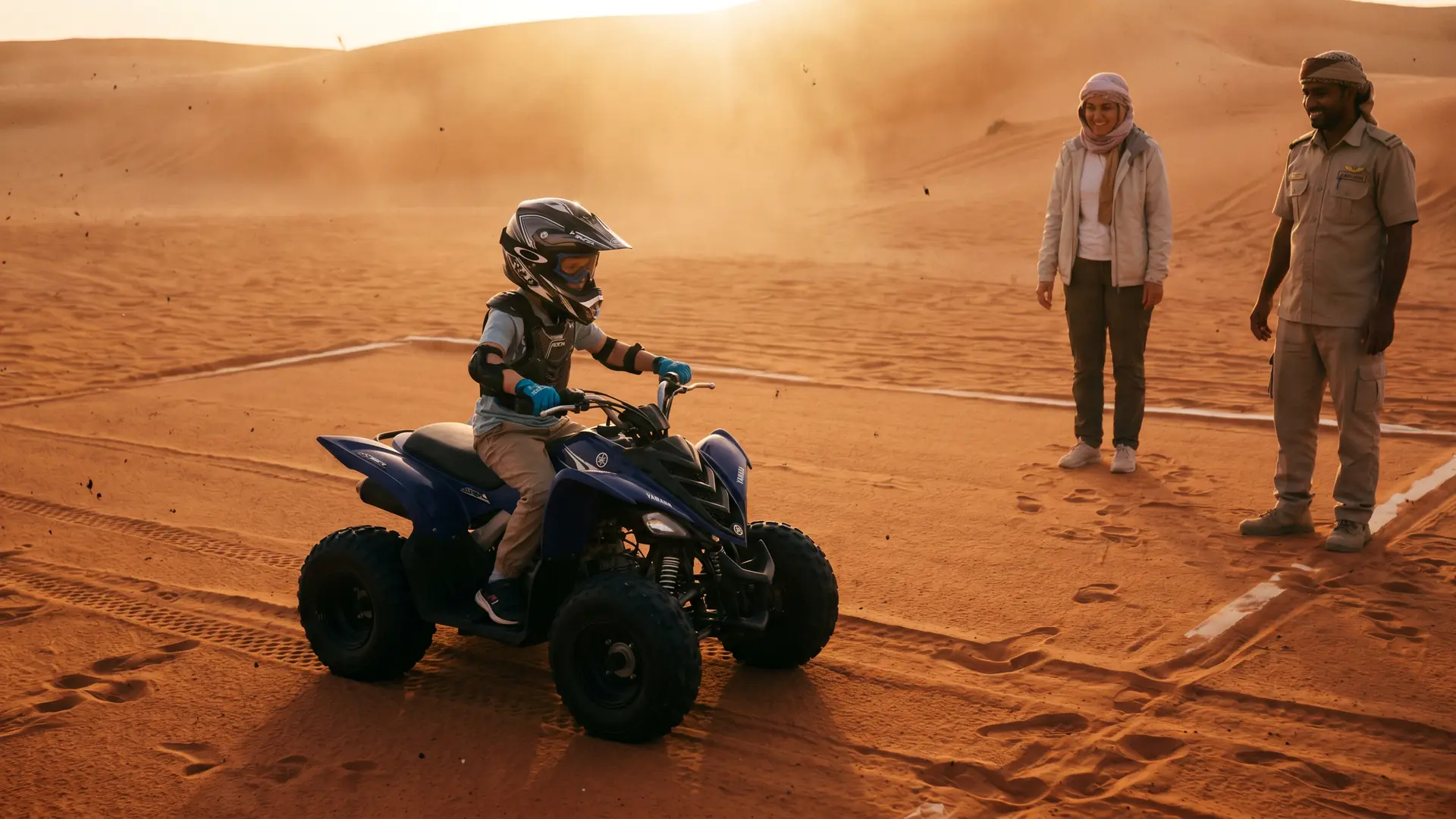 AED 150
Kids stay on the flat 90cc loop while the adults take a full route across the dunes — same base, same time window, no separate wait for anyone in the group.
Book a family tourA steering wheel doesn't count toward this — think motorbikes, jet skis, anything you've already ridden with a throttle under your right hand.
The drive out shapes this booking more than most people plan for.
An ATV asks you to read the ground through your own body weight. A buggy filters that same terrain through a roll cage, a harness and a wheel instead. Plenty of groups here book both.

The calmer way onto the same dunes. Predictable over changing ground, and easy to correct if a line goes wrong.
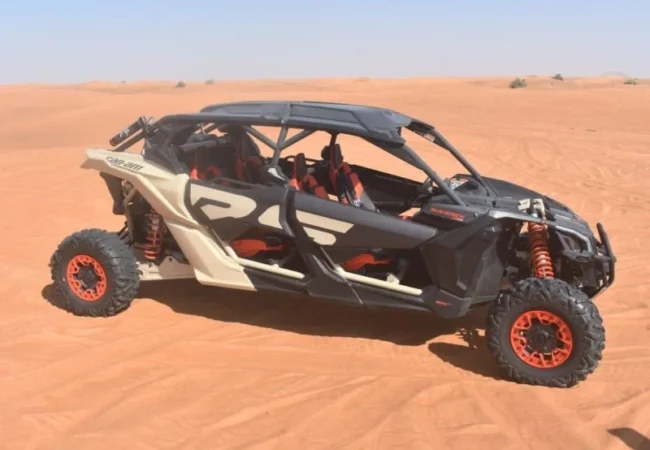
Wide-set and long-travel, built to soak up the same ground an ATV rider feels through the bars. One fee for the whole vehicle, not each seat.
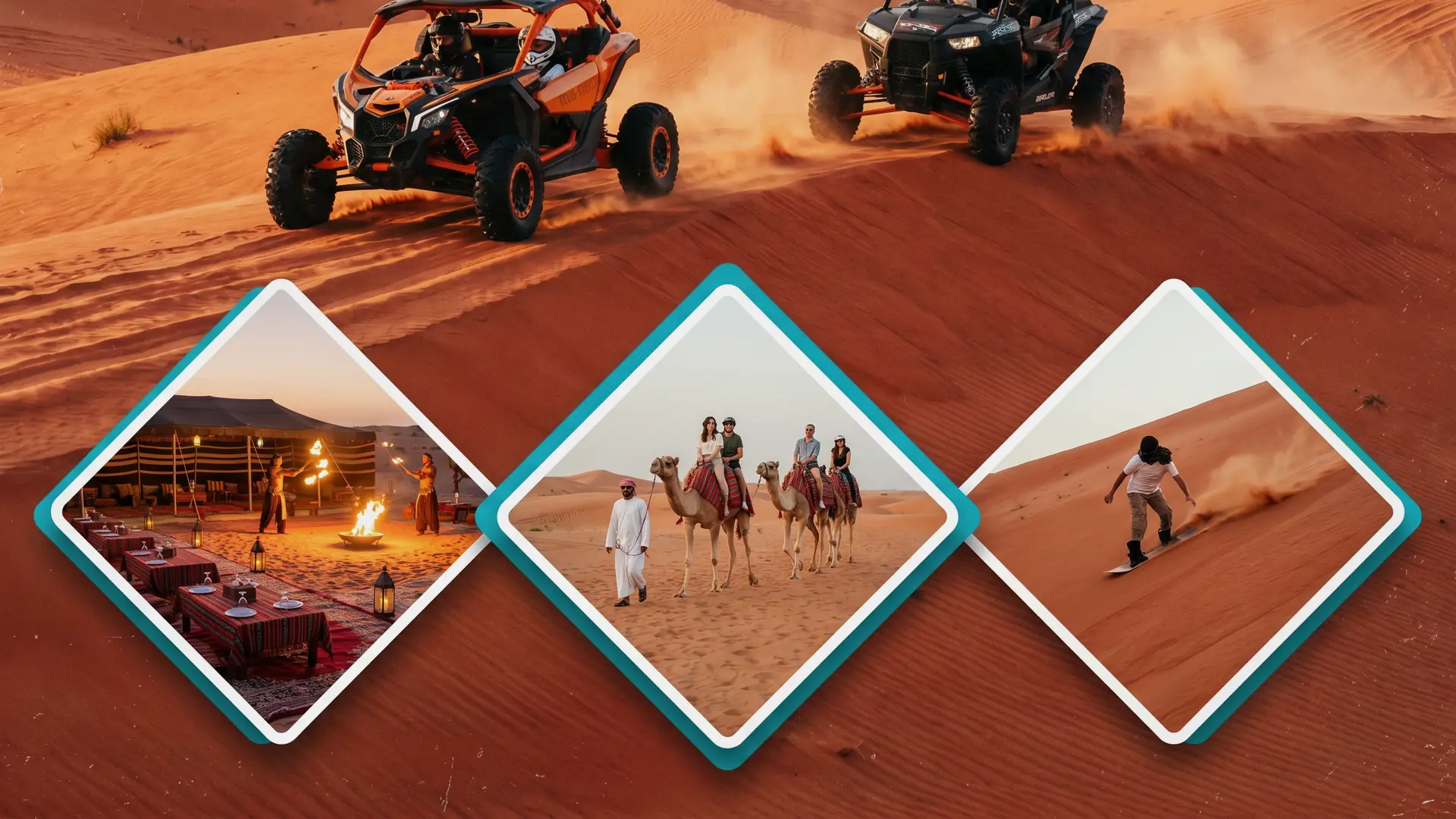
Take the ATV leg first, while your grip is still fresh, then swap into the buggy for the rest of the ground. Numbers for this one typically fall in the AED 290 to AED 1,100 bracket, depending on which machines you choose.
Two wheels expose a mistake in soft sand that four wheels would just absorb, and a KTM does none of the balancing work an ATV quietly does for you — which is why questions come before a yes here, and nowhere else on the site.
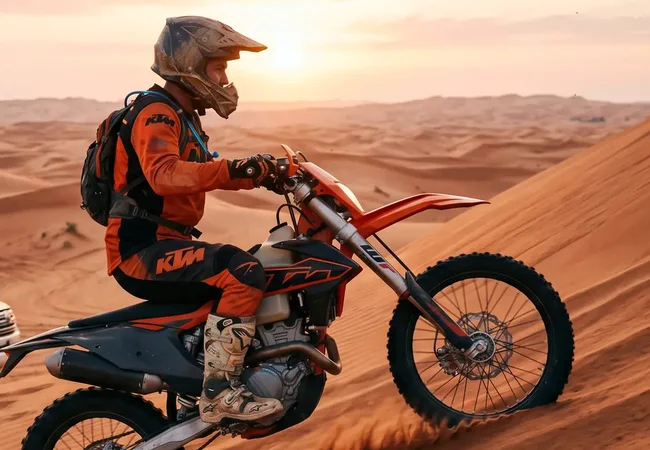
One hour is AED 850, two hours AED 1,250. Bring real off-road hours on two wheels, not just enthusiasm for the idea of it.
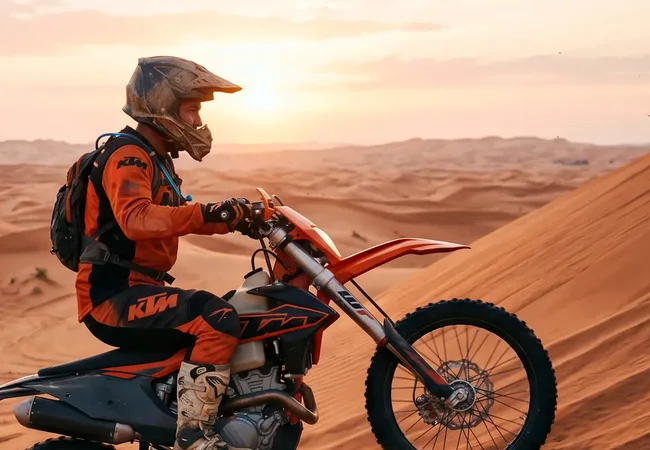
Kept for the hardest ground on the advanced route, and only handed over once a guide has watched you ride. Price gets confirmed after that, not before.
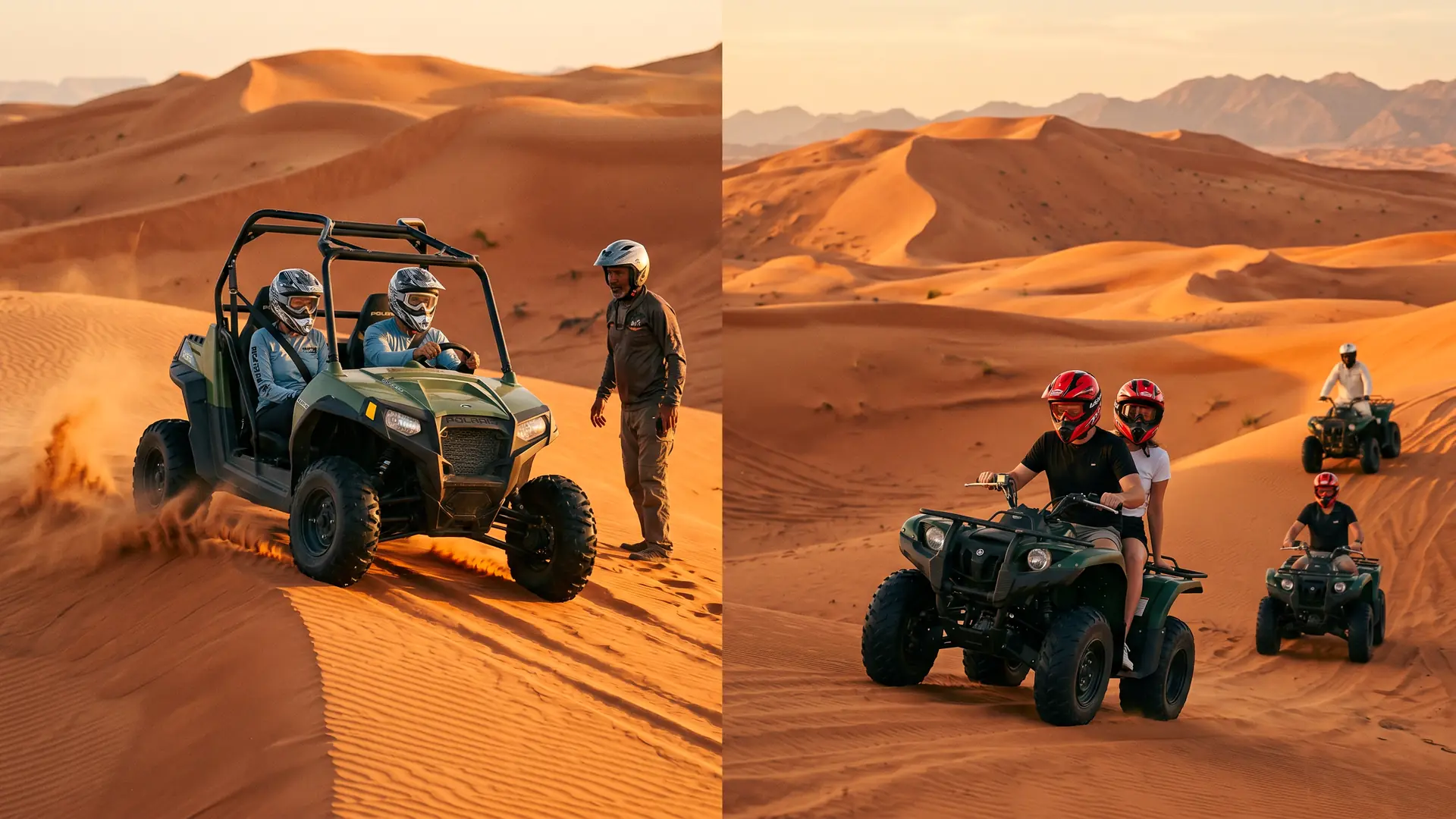
Didn't pass the KTM check? The Raptor 700cc covers much of the same terrain at nearly the same pace, with four wheels doing some of the balancing for you.
A professional driver crosses the same dune faces you'd otherwise ride yourself, in a Land Cruiser safari starting at AED 225. Most mixed groups end up booking one alongside the ATVs.
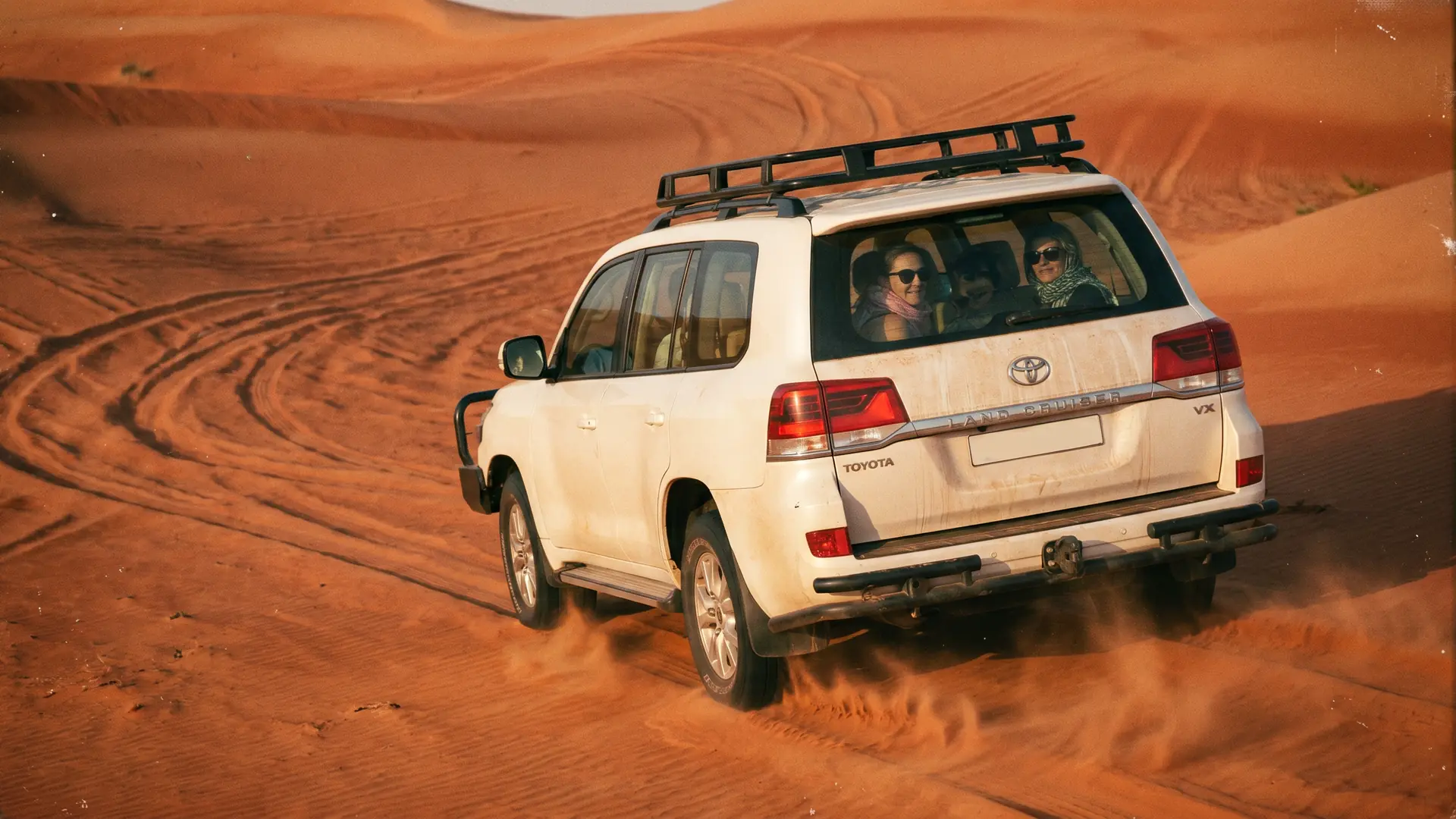
Out early while the dunes are still holding the night's cool, back in the city long before lunchtime hits.
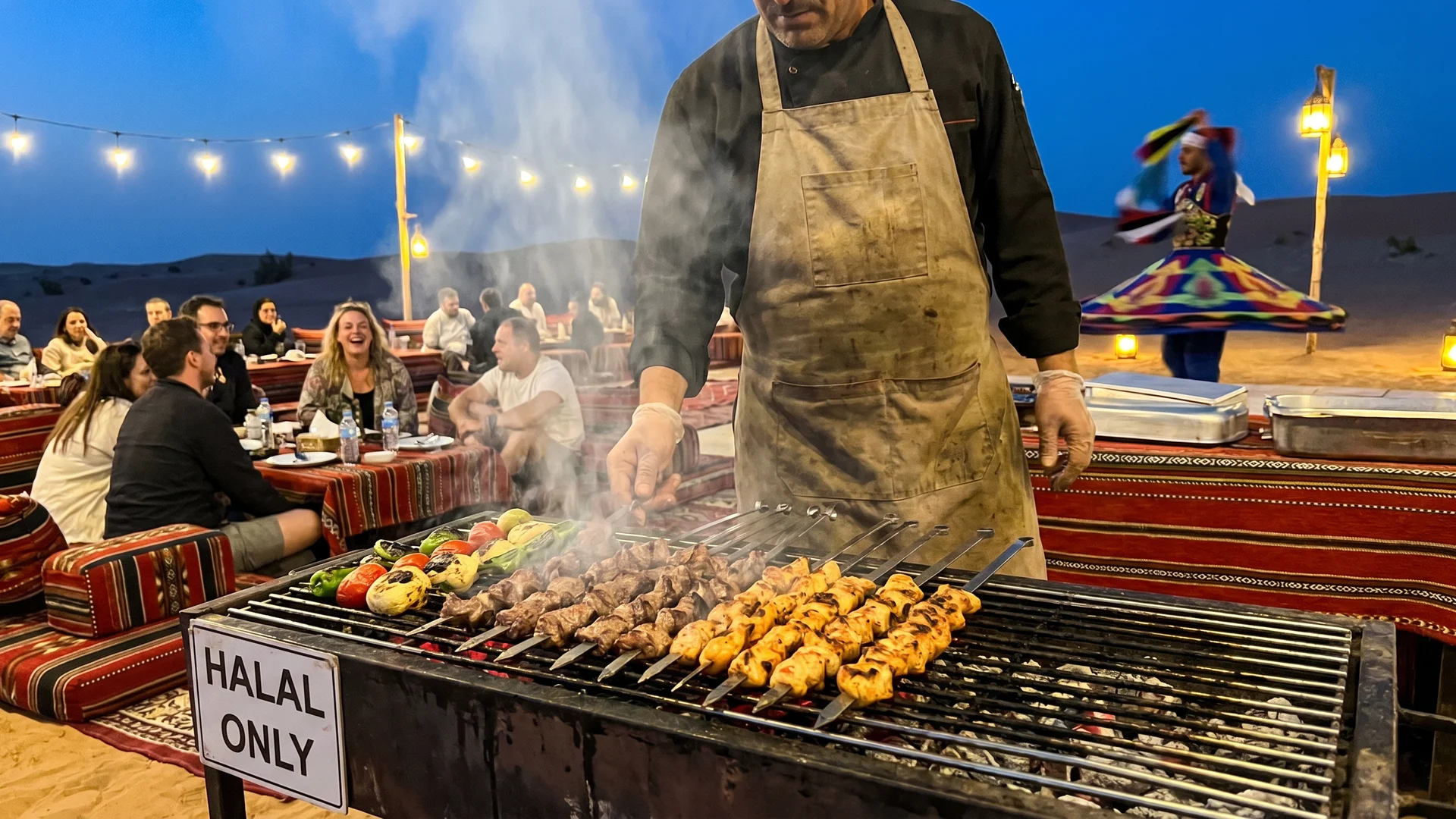
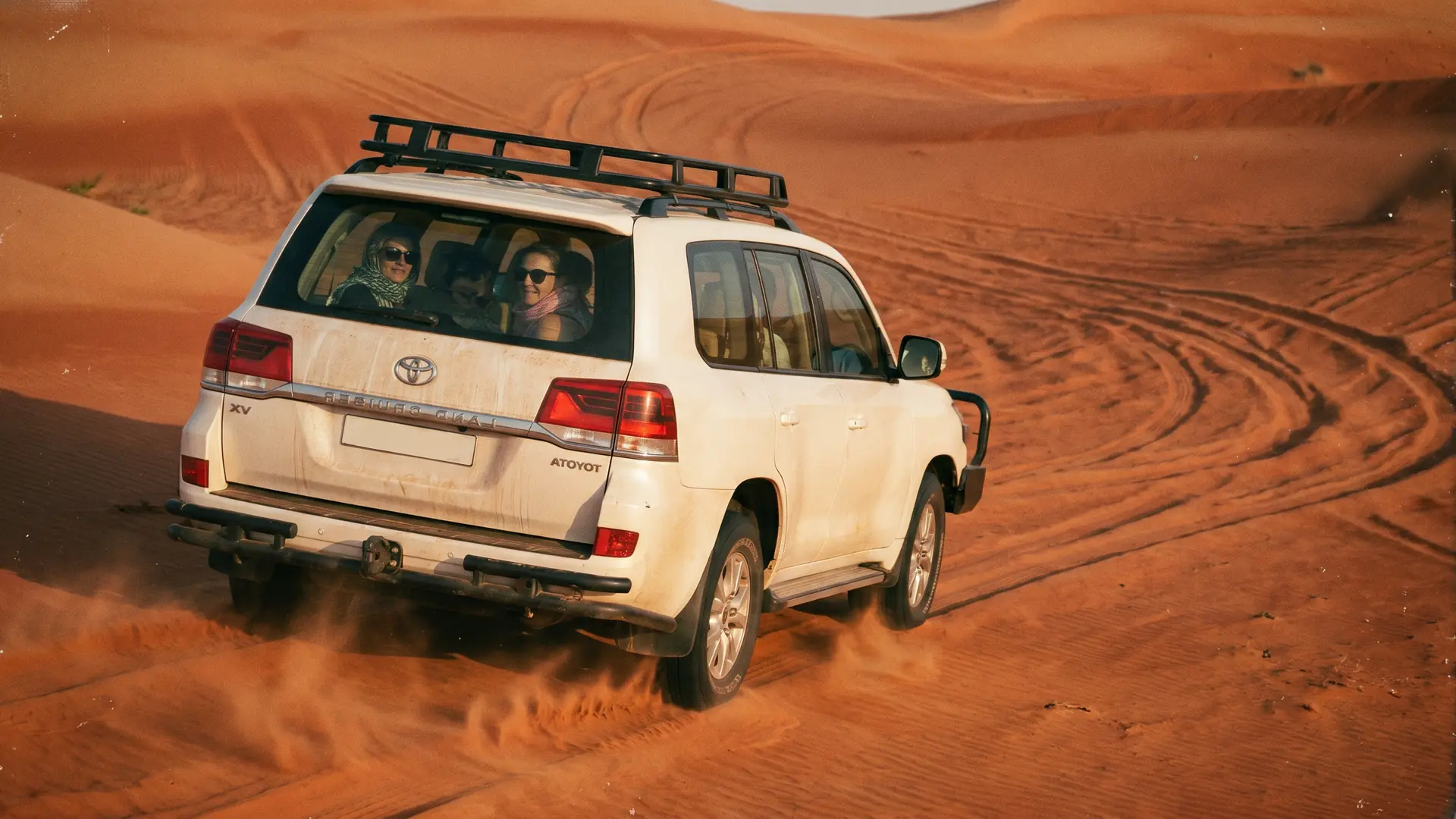
Dune bashing while the light softens, then a halal BBQ spread at the camp, with the ride there and back both included.
A dedicated vehicle just for your party, with seating held at the camp so nobody's squeezed into a shared schedule, and the route built entirely around what your group wants.
Beyond the packages listed here, a handful of custom requests run on the same dunes: go private for a morning departure at AED 799 or an evening one at AED 1,400, book an overnight camping trip, or arrange a corporate group outing. Anyone whose stomach won't tolerate dune bashing can ask for a calmer, flatter route instead.
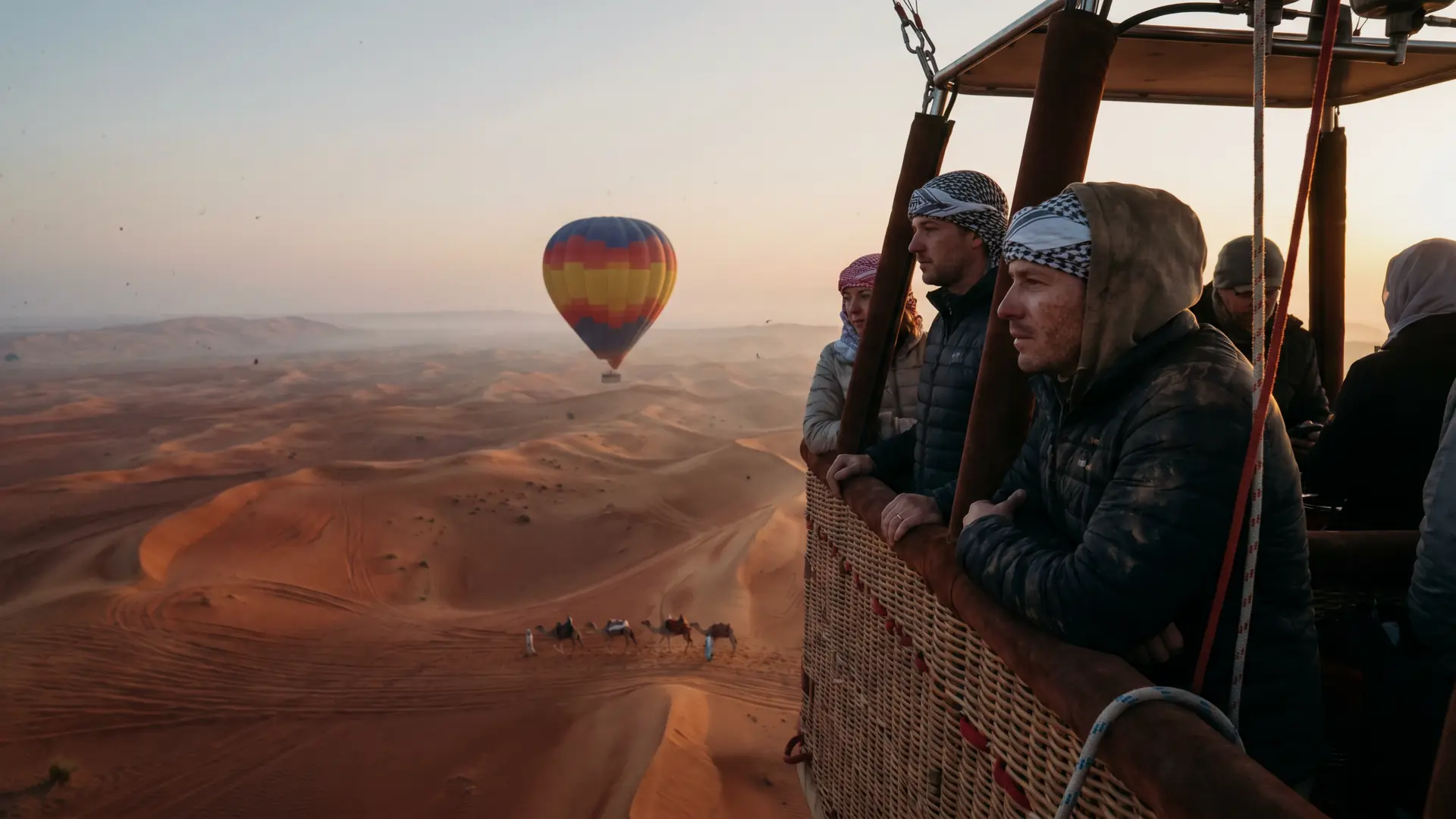
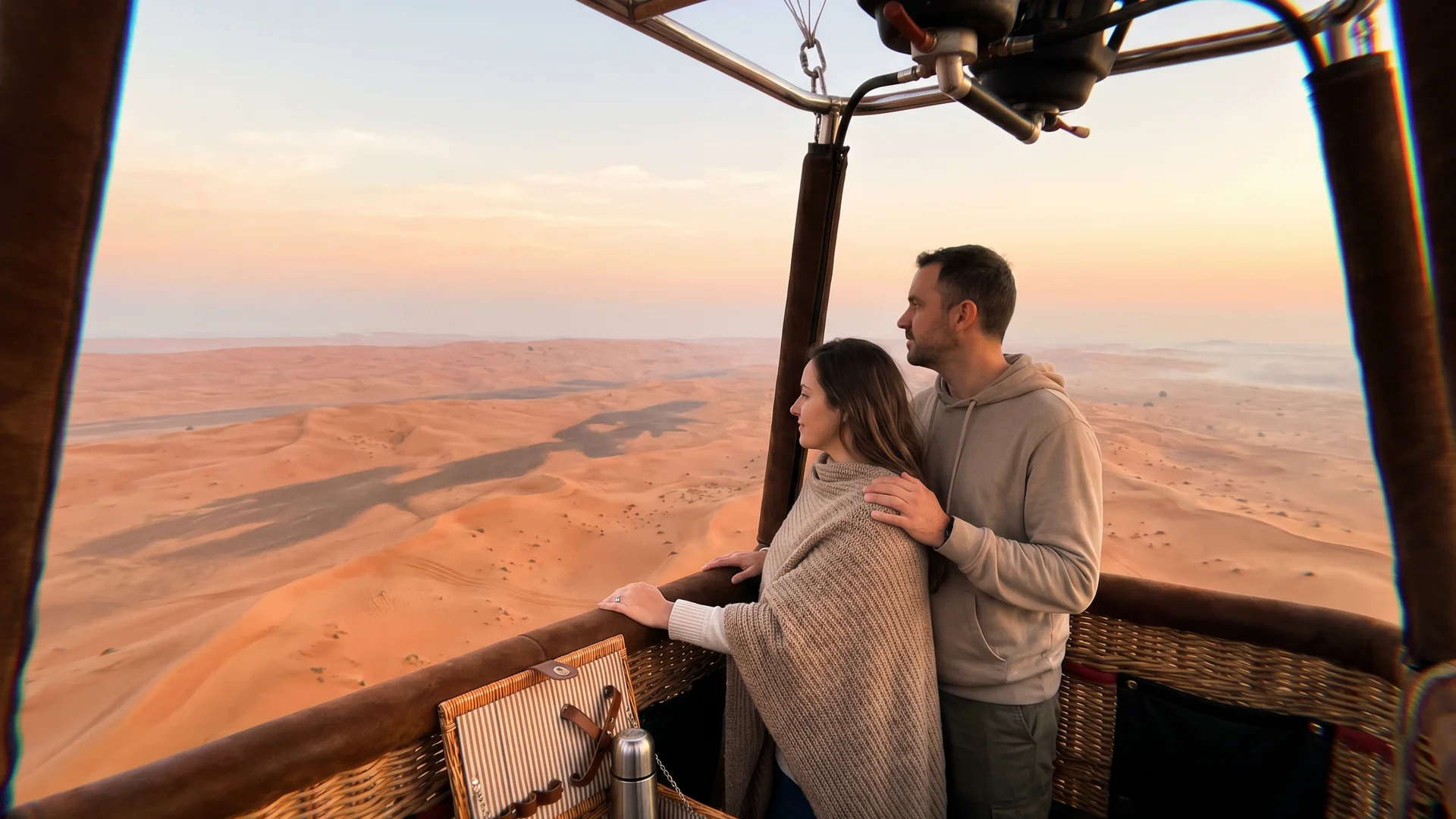
Guests are collected around 4:30 AM and touch back down while hotel breakfast service is still running. Flights operate from September through May, and no other booking on this page is as weather-dependent — a rough morning grounds a balloon long before it affects anything else here.
Well suited to the smallest riders in your group, older relatives happy to sit this one out, or anyone who eyed up the Raptor and thought better of it.
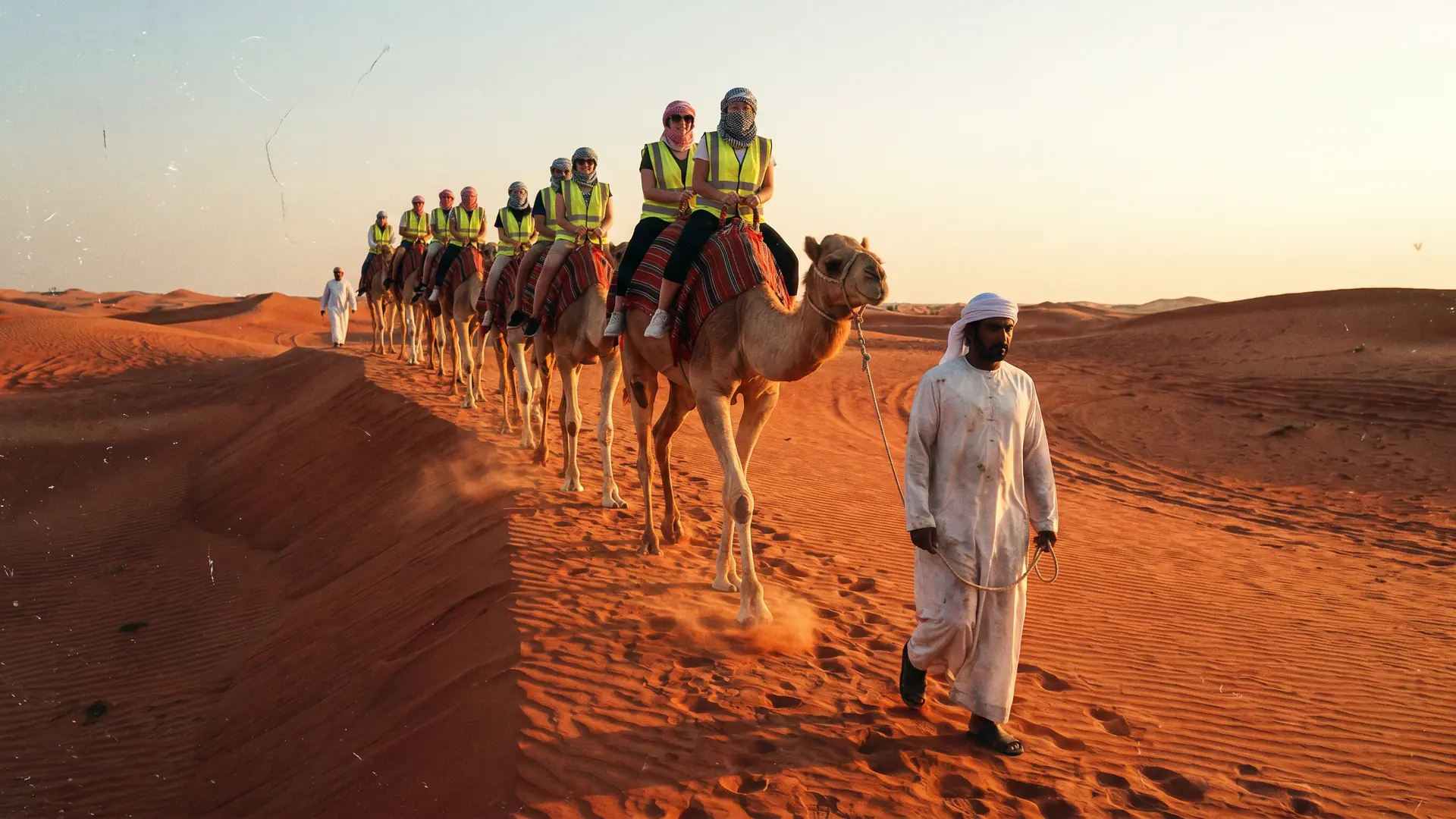
A handler leads the walk across the same red dunes the ATVs cover. Children as young as three can join, provided an adult rides too.
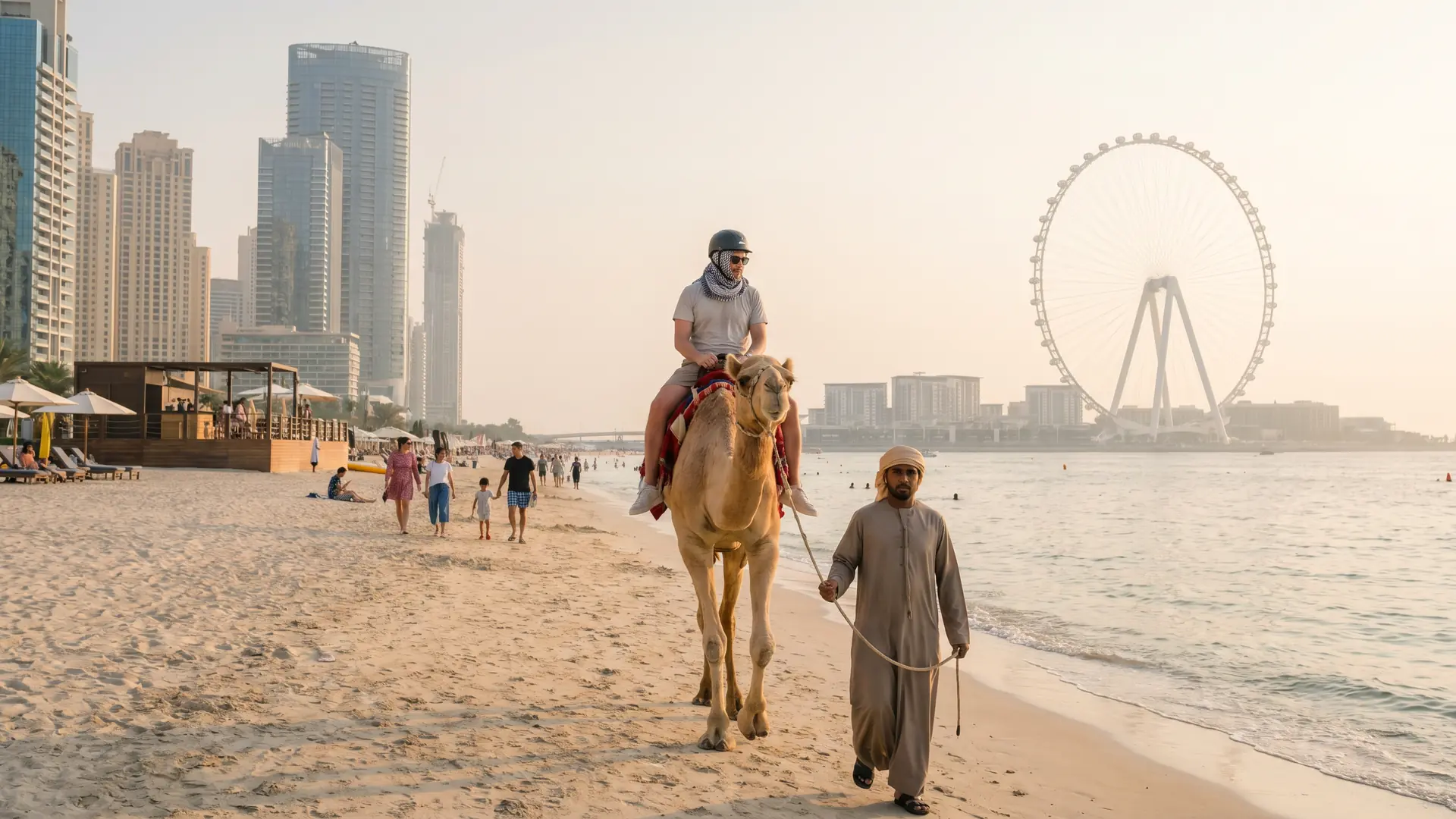
Already on the JBR sand itself, so there's no drive out involved — and it's usually the photo people are chasing most on this list.
There's also desert horse riding on offer, starting at AED 575, aimed at riders who already have saddle time behind them.
These don't run off a fixed price sheet — headcount, machine choice and how much of the day you're setting aside all move the final number. Send the details over and a quote comes back the same day.
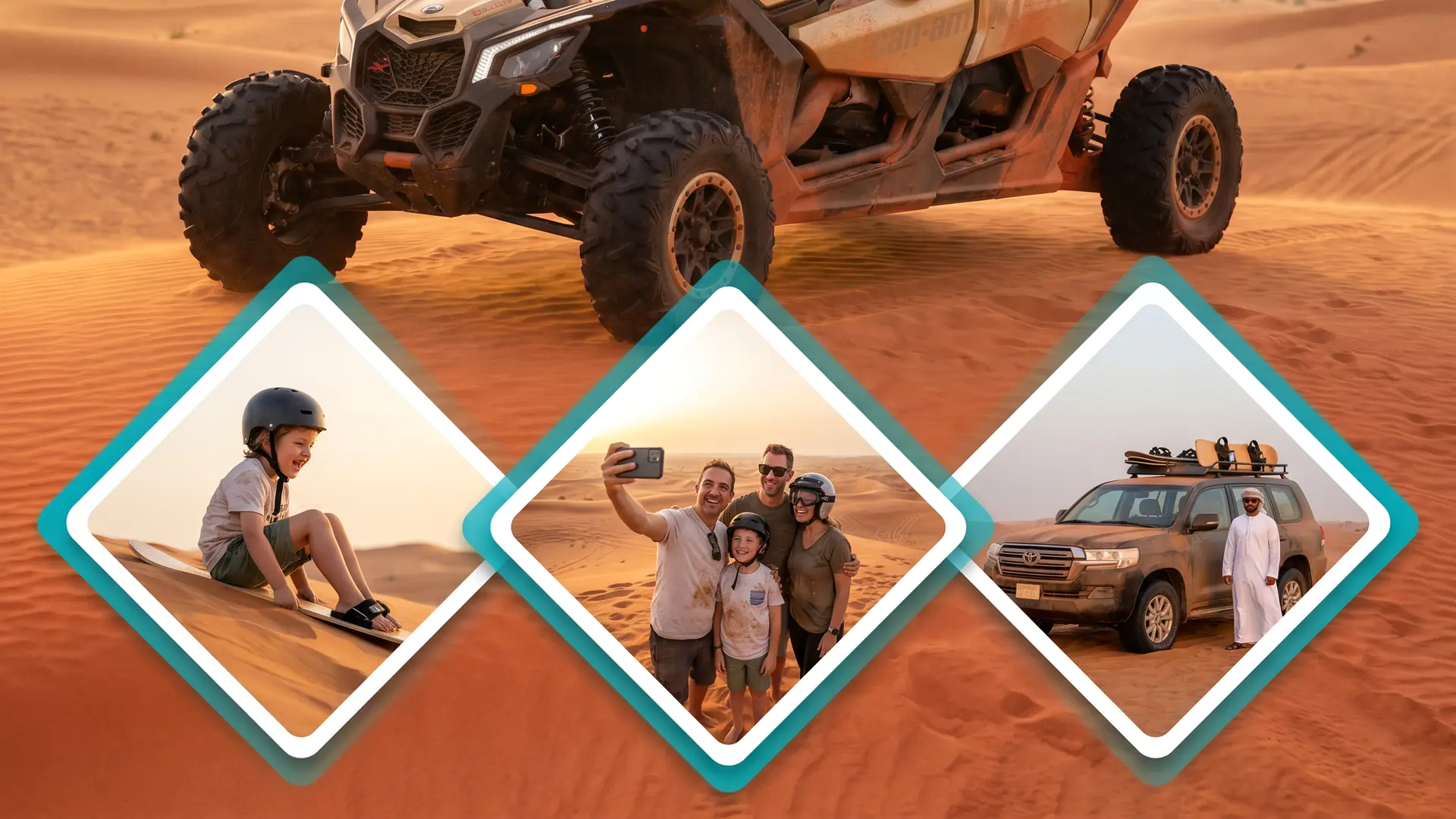
Combine every machine in one outing — ATV, buggy, safari and the BBQ camp — and pricing generally lands between AED 700 and AED 2,200. Tack a sunrise balloon onto the start of it and that becomes the full-day version.
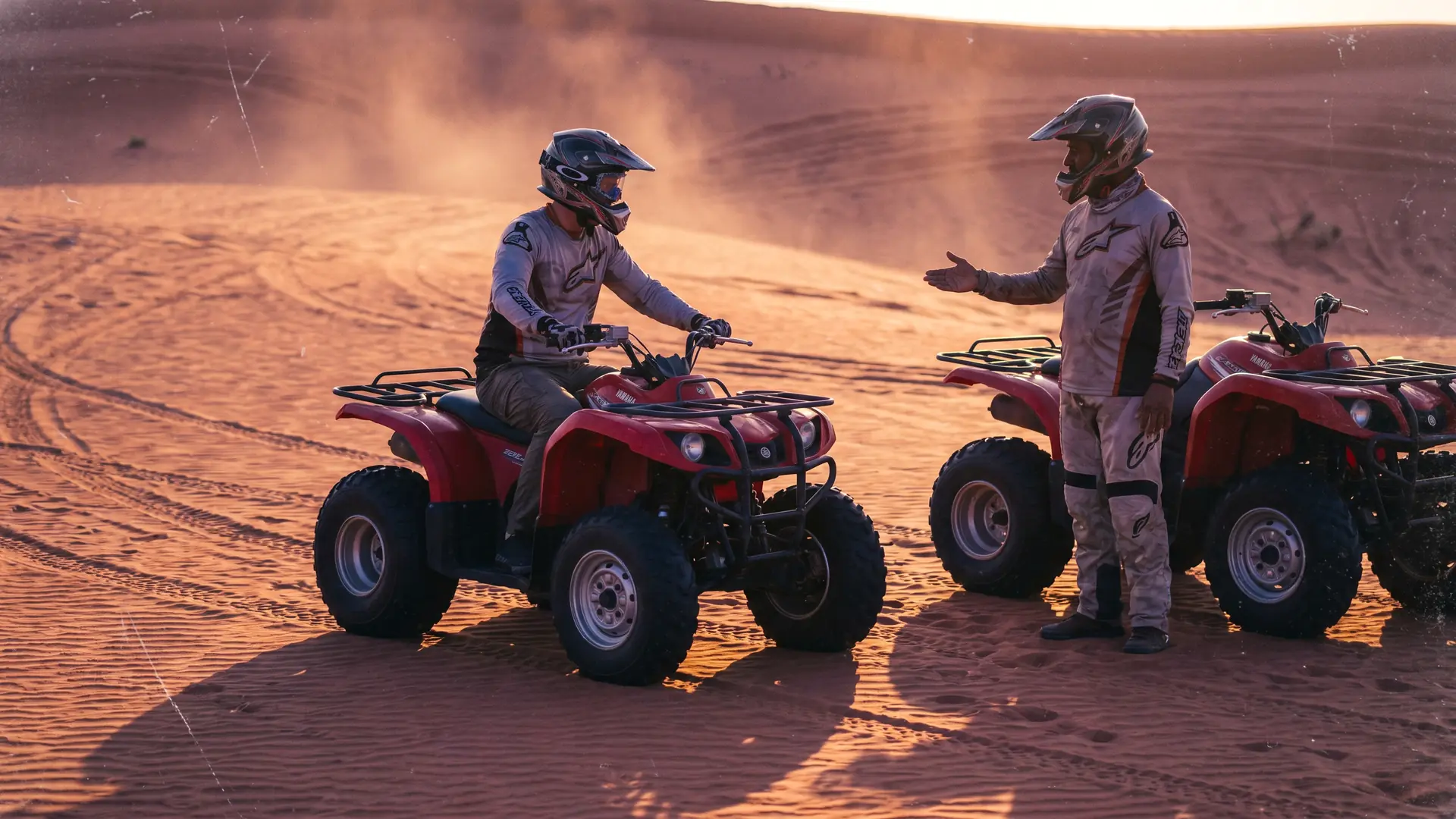
Groups of twelve or more split across ATVs and buggies, riding behind the same guides on a fixed schedule.
Every ATV, buggy and dirt bike session on this site runs from one location: Al Lahbab, tucked southeast of the city just off the road toward Al Ain. The deep red sand in the photos is genuinely that colour in person, and the ground behind it matches too — real dune bowls with height and shape to them, not the worn-down mounds you find riding closer to the highway.
Nobody points a machine at a dune until a short, flat patch of ground back at base has done its job first. That warm-up carries most of the safety structure here on its own, since it's the moment a guide actually works out what terrain suits you.
Six steps in the same order every time, whether it's the standard loop or a stacked full day. What stretches or shrinks is only the riding stage in the middle.
City-based riders get collected directly; anyone driving themselves gets a pin dropped for the meeting point as soon as the booking is confirmed.
Helmet and gloves go on first, then a full walkthrough of the controls: how the throttle responds, how to brake without locking the wheels, how to shift your weight once the ground turns rough, and the one hand signal that means stop right away.
First comes a short stretch of flat sand, where the guide clocks how you're handling the machine and uses that to pick the route that suits you.
From there it's single file behind the lead rider, crossing bowls and ridgelines with the odd pause built in wherever the light is worth stopping for.
Back at base: water, a breather, and your photos handed over. From there it's either straight back toward the city or on into whatever else got booked.
Booked the BBQ? The group rolls straight into the halal camp from here, with no separate detour needed.
Riders between nine and twelve handle the 90cc loop with a guardian stationed close by. Anyone younger can still join in as a buggy passenger next to the driver, or sit on a camel from age three upward. If anything in your group falls into a grey area, mention it before payment rather than saving it for the briefing, so there's real time to sort it out. Dream Land Adventure Tourism holds a DTCM licence for this operation, and once everyone's out on the dunes, the guide's read of the terrain is what decides what happens next.
Based on 1,258 Google reviews
Based on 721 reviews
Every rider pays per machine, not per group, across the eight-strong Yamaha lineup. Children start on the supervised 90cc at AED 150, while adults with zero riding history step up on the 220cc from AED 200. Most adults settle on the 400cc at AED 250, which carries enough power for the standard route without demanding real skill yet. Top of the range is the Raptor 700cc at AED 795, only signed out once a guide has watched you ride. Bolt on a Land Cruiser safari plus the BBQ camp, and the combined package prices out at AED 290 for a morning departure, or AED 375 if you'd rather ride it in the evening.
Yes. ATV is the term you'll hear more often outside the Gulf, while quad or quad bike is the word locally and across the UK. Both describe the same four-wheeled, single-rider machine on this page — whichever term brought you here, you're looking at the right fleet.
The drive out to Al Lahbab takes about 45 minutes from Downtown, heading southeast on the road that continues through to Al Ain. That time isn't wasted: the sand only turns properly deep red and holds real height once you're past the paler, flatter ground nearer the highway.
You won't be asked for a licence, since every metre of this ride stays on private desert land rather than a public road. Complete beginners are just as welcome — mention it at the briefing and you'll be placed on the 220cc, the machine built to forgive a shaky first attempt. That flat-ground warm-up beforehand isn't a formality: it's how a guide actually gauges your ability and works out how much terrain you're ready for before the ground starts climbing.
There's always a guide out front. Your machine is your own to handle, but the route, the gaps kept between riders and every stop called along the way come from the lead guide. Solo riders never get turned loose on the dunes, and the whole group rides at whatever pace its most cautious member needs.
Age nine is the cutoff to ride solo, on the supervised 90cc loop with an adult stationed close by, priced at AED 150. Below that, children can still ride in a buggy's passenger seat next to whoever is driving, or hop on a camel starting at age three.
Pickup isn't folded into the machine price — it's quoted as a separate line before you commit to paying. Regular collection runs from Marina, JBR, Downtown, Business Bay and Deira, and if you'd rather drive yourself, directions to the meeting point land the moment your booking is confirmed.
Set aside roughly half a day once you factor in the road time. The dune-loop session itself is a single sitting, but Al Lahbab sits about 45 minutes outside central Dubai each way — far enough that pairing the ride with a safari leg or a camp dinner makes more sense than making that drive for one short outing on its own.
Closed-toe shoes are essential, plus sunglasses and an outfit you won't mind losing to sand — helmets are provided. If you only pack one extra item, a face buff or scarf earns its place more than anything else on this list. A change of clothes left in the car makes the ride home far more pleasant.
It happens on most tours — usually a rider eases off the throttle too early on a climb, and the machine settles into the sand instead of carrying through it. A guide loops back, hooks on a strap and has you moving again within a couple of minutes, no charge involved.
Pick ATVs when everybody in the group wants to twist their own throttle, since pricing runs per person. A buggy fits better when only one or two in the group actually want to steer, because it's priced per vehicle rather than per seat, so the total stays the same no matter how many climb aboard. Mixing both is common too: some take a buggy, others take ATVs, and everyone still ends up on the same route behind the same guide.
Sessions continue, just shifted to the edges of the day. Late May through September pushes bookings into early morning and late afternoon, since midday heat over open sand is genuinely too much to ride through. October through April, any hour of the day works comfortably.
Sandstorms and strong wind get a session rescheduled rather than cancelled outright, and you'll hear from the team beforehand with a fresh set of times to pick from, at no added cost. ATVs actually cope with marginal weather better than most other bookings here — the balloon flights are the first thing grounded.
A midweek slot usually only needs a couple of days' warning. Weekend dates are tighter — give those closer to a week if you can, since late-afternoon sessions and the Raptor 700cc are the first to sell out. Secure online advance payment confirms your booking, and pickup timing gets finalised on WhatsApp the evening before you ride.
Terrain is the whole reason this ride is worth the drive: red dune sand that holds firm in places and turns loose and heavy a few metres on, crossed on an eight-machine Yamaha fleet. Children get a supervised 90cc loop of their own for AED 150, the Raptor 700cc sits at the top of the range for AED 795 and only goes out with riders a guide has personally watched handle a machine first, and most adults end up on the 400cc at AED 250 — enough weight and pull to handle the gradient changes across a standard route without needing textbook technique underneath it.
Worth knowing before you pick a package: a Land Cruiser dune-bashing leg, your own ride timed for when the sand is cooling and firming back up, and a camp dinner to close the evening, all sold together as the Evening Desert Safari with BBQ for AED 375, the most-booked combination on this site. Secure online advance payment confirms your booking, support available 24/7.
A 4x4 leg first, then your own machine as the ground firms up for the evening.
AED 375Overnight cooling works the sand into its most forgiving state of the day.
AED 290Enough weight and pull to carry mixed gradient without needing perfect technique.
AED 250Cleared rider by rider before it gets pointed at the tallest faces.
AED 795Light steering that forgives a wandering line on a first ride.
AED 200Kept off the open dune field, on ground that never changes character.
AED 150The same terrain filtered through a roll cage instead of body weight.
From AED 599No four-wheel margin for error on the same shifting ground.
From AED 850Not one surface but several stacked close together — a firm base under a shifting top layer, broken by ripples, cusps and the odd buried hollow that only announces itself once a wheel drops into it.
The first thing riders notice is that the ground rarely stays the same for more than a few seconds. Cross a stretch that feels almost like a packed trail and the next metre can drop a front wheel into a pocket nobody would have spotted from a standing start. That is not bad luck, it is simply what a dune field does — wind stacks sand into ridges and hollows constantly, so the surface a machine is actually gripping changes texture more often than the eye can register from the saddle.
Handlebars pick up on this before your eyes do. A quiet section of trail transmits a steady, low buzz through the grips; a looser patch goes soft and slightly delayed, almost like steering through syrup for half a second before the front wheels bite again. Riders who have only driven a car or ridden a bike on tarmac often describe that as the strangest part of the first ten minutes — the machine talking to your hands constantly, rather than staying quiet until something goes wrong.
Colour plays into the read too, though less than visitors expect. The red tone across Al Lahbab holds fairly evenly across the whole field, so it is shadow, ripple pattern and the angle of a dune face a guide is actually reading, not shade of red. That is also the entire logic behind starting every session on flat ground: a few minutes to feel what normal feedback through the bars is supposed to be, so the first genuinely soft patch on the real route does not arrive as a surprise.
Some faces around Al Lahbab are barely a rise; others stack up close to the point where loose sand simply cannot hold any steeper and starts sliding under its own weight. An ATV needs a different rhythm on each.
Height varies wildly from one part of the field to another. The rolling approach dunes near the base climb so gradually that most riders do not consciously register them as a climb at all — throttle stays where it was, body stays put, nothing changes. Further into the bowls, the faces get dramatically taller and noticeably steeper, and there is a natural ceiling to how sharp that angle gets: pile loose sand any steeper than a certain point and gravity simply drags it back down before a wheel ever reaches it. That is the terrain the tallest slip faces sit right up against.
Climbing one of those tall faces rewards commitment over caution. A rider who eases off halfway up loses the momentum that was carrying the machine forward, and once that happens the wheels start digging rather than driving — the fastest route to getting stuck out here. The technique runs almost opposite to instinct: hold the throttle steady, lean your weight into the hill rather than away from it, and trust the climb to finish rather than second-guessing it partway up.
Getting back down asks for the reverse. Weight comes back rather than forward, the throttle eases off rather than staying committed, and the machine gets allowed to settle its own way down rather than being driven down aggressively. Carry climbing habits into a descent — leaning forward, staying on the gas — and the front end can go light in a way that feels wrong immediately, even if it rarely turns into anything worse than a startled rider. A guide watching from below usually calls this out before it becomes a pattern.
There is a fourth scenario beyond straight climbing and descending: riding along a ridge rather than over it, with the slope falling away on one side rather than sitting in front of you. That is when body position does the most work of the whole ride, shifting toward the high side so your weight sits over the machine instead of the hill pulling both of you toward the low edge. It is not something a rider figures out from a diagram — it is exactly why the route only opens up in stages, based on what the flat warm-up showed a guide about how you actually ride.
Firm ground answers a steering input almost instantly. Loose sand takes a beat to respond, and sometimes ignores the bars altogether in favour of wherever your weight is already headed — which is why technique here leans more on body position and throttle control than on the handlebars.
Down in the lower stretches of the bowls, particularly before the sun has had time to heat things up, the sand at Al Lahbab packs into something that rides close to a firm dirt trail. Point the bars somewhere and the front wheels go there. Brake and the machine actually stops rather than sliding on regardless. Small corrections hold a line without a fight. This firmer ground is deliberately where the 220cc spends most of its time, and it is the exact stretch every session's warm-up happens on.
Move higher onto ground that is properly loose and the machine starts behaving differently almost immediately. Instead of biting into the surface, the front wheels plough through it, so a steering input that would turn the machine sharply on firm ground barely nudges it here — momentum and body weight end up deciding the direction more than the handlebars do. Riders who do not adjust keep cranking the bars harder, which mostly just wastes effort against a front end that is not listening the way it did a few metres back.
What actually works is closer to a different skill entirely: settling weight low and slightly forward, feeding the throttle in one smooth, continuous motion instead of stabbing at it, and letting the machine's own momentum carry the turn rather than forcing it through the bars. None of this is obvious walking in — it runs against everything firm-ground riding teaches — which is why the first proper loose stretch of a session is usually where a rider's technique visibly clicks, or does not yet.
The genuinely tricky part is not riding firm ground or riding loose ground on their own — both become manageable fairly fast. It is the handoff between the two, often happening across a single turn of the wheels with no warning beforehand. A rider still leaning on firm-ground habits gets caught out exactly there, and it is precisely what a guide is watching for during the warm-up: not top speed, but how fast someone recalibrates once the ground underneath them changes character.
The clock and the calendar both change what is under your wheels. Sand that cooled all night rides differently to the same stretch three hours after sunrise, and a hard wind can rearrange a dune's shape before your next visit.
A night's worth of cooling leaves the top layer of sand measurably more settled than it will be once the sun has been working on it for a few hours. It is a subtle shift in absolute terms, but it is the difference between wheels sitting on top of the sand and wheels sinking into it. That is a large part of why the morning safari and ATV pairing suits riders taking their first-ever session so well — the ground is doing them a favour before they have even climbed on.
Wind reshapes more of this landscape across a season than heat does. A single strong blow can flatten one edge of a ridge while piling sand deeper on the other, or scrape away a soft layer to expose something firmer that had been buried for weeks. There is no pattern to when this happens, which is exactly why a guide reads the dunes at the start of every session rather than running the same route from memory — a line that felt predictable a month ago can genuinely ride differently today.
The clock turns back the other way come evening, with the day's heat draining out of the sand and the surface firming up again — timing that is built directly into the evening safari, ATV and BBQ package rather than being incidental to it. A dust event does more than fog up the view, too; it can quietly rework whatever ground a postponed session ends up crossing, so a slot pushed to the next day is not always riding quite the route that got planned originally.
A flat lot or a groomed track gives every lap the same surface and the same corners. Desert terrain will not repeat itself the same way twice inside a single session, let alone across two different days.
A practice yard or a motocross circuit gets built for consistency — graded flat or shaped with berms that hold their form lap after lap, on purpose. Dune terrain was never built for anything, and it shows. The same stretch of trail can shift from solid ground to a soft patch to a wind-crusted ridge inside a handful of seconds, with nothing marking the change the way a painted line would on a circuit.
What a flat surface also removes almost entirely is elevation, and with it a whole set of decisions most riders never think about until they are suddenly required: reading whether a slope is worth committing to, picking a path across a ridge rather than aiming straight over its crest, shifting weight one way for a climb and another way entirely for a descent rather than just leaning into a bend. None of that exists on a flat lot, and all of it has to be picked up, at least at a basic level, before the desert stops feeling foreign.
That gap is exactly why nobody heads for real dune terrain without the flat warm-up first — a chance to test control on ground everyone already understands before the unknowns of the dunes get layered on top. It cuts both ways, too: a rider who handles a session at Al Lahbab well is juggling more variables than a track alone would ever ask for, which usually shows the moment they are back on flat ground afterward and it suddenly feels almost too easy. Calling the desert simply harder than a track undersells it — the ground itself keeps changing mid-ride here, something a graded track is built specifically never to do.
A dune crest hides whatever sits on the other side of it. A side-slope pulls a machine sideways as well as down. And firm ground can turn to soft sand with no warning between one wheel-turn and the next — three things flat land simply does not do.
Coming up on a dune crest means riding toward a point where you genuinely cannot see what is beyond it until you are already there, nothing like a track corner, which stays visible the whole way through. That is the reason a lead guide always takes any crest first, and why keeping distance between riders matters more out here than it would somewhere with a clear sightline. Ride too close to the machine ahead and you lose the room to react to whatever that blind crest was hiding.
Crossing a dune along its side, instead of climbing it straight up or down, means riding a slope that pulls a machine sideways as well as downward — a genuine tip hazard unless weight gets shifted uphill to counter it. Speed has little to do with this one; it is purely the shape of the ground at work, and it is a factor a guide is always weighing when deciding how narrow to keep a line along any given ridge.
A third risk worth knowing about is the same firm-to-soft handoff covered earlier in this guide, arriving with no visible cue beforehand and enough to pitch a rider's weight forward if the throttle is not eased at the exact moment the ground gives way. None of this is a reason to hesitate about booking. It is the reason the whole session leans on a guide reading live terrain instead of following a route drawn on a map beforehand, backed by a helmet on every rider, a machine checked in front of you before handover, and the final call always sitting with the guide once anyone is out on the sand — alongside the medical exclusions covered on the safety page.
Al Lahbab offers taller, connected dune country with real climbs built in. Al Awir sits lower and closer to town; Big Red is one famous dune rather than a whole field of them. This guide's technique points are written for Al Lahbab specifically.
Al Awir, being nearer the city, runs flatter and more open, without anything like the height or continuous gradient found further out at Al Lahbab — a fine stop for a quick look, less useful for a route built around genuine climbing and descending. Big Red, out toward Hatta, is a different case again: one very tall, very famous dune rather than a spread field, with a surface worn looser by constant sandboarding and day-trip traffic than anything a managed session sees here.
Neither substitutes for the ground this guide has actually been about. The gradient handling, the firm-to-soft technique shift and the terrain-specific hazards above are all written around Al Lahbab's particular stretch of tall, connected bowls and ridgelines — terrain that keeps its shape between visits instead of getting worn flat by constant open traffic. The extra distance from the city is essentially the cost of riding ground that still behaves like proper dune country.
Rarely for long. Even a short stretch of trail mixes firmer patches with looser pockets, which is why the handlebars stay active through most of a session rather than going quiet once you're moving.
Nothing close to the tallest slip faces on the fleet's advanced routes. A guide keeps first-timers on the gentler approach slopes until the warm-up shows they're ready for more gradient, not before.
No — the 220cc and 400cc are both set up to forgive a front end that answers late on loose ground, and the warm-up is specifically there to see how quickly you adapt before any real climbing gets folded into your route.
Genuinely firmer. The top layer of sand measurably settles overnight, which is why the morning safari and ATV combo tends to suit first-timers particularly well.
They can, and sometimes noticeably. One properly windy stretch is enough to shift where a ridge sits or fill in part of a bowl, so a guide checks the ground fresh at the start of every session rather than trusting what a route looked like last time.
Wind carves the surface into ripples that barely register to the eye from a standing distance but come through clearly the moment a wheel rolls over them — one of the more surprising sensations for anyone used to riding on pavement.
Steering harder instead of easing the throttle and shifting weight — exactly the instinct that makes an ATV fight back on a loose face rather than settle into it.
They add a real sideways pull a flat track never introduces, which is why leaning into the high side matters more than speed does. It's a factor a guide weighs when deciding how tight a line to hold.
Not especially. Big Red carries a single, well-worn dune surface shaped by constant sandboard and visitor traffic, while Al Lahbab spreads a whole field of bowls and ridges that see nowhere near that level of daily wear.
It does. A heavier, planted machine like the Grizzly 450cc holds its own better across a longer, mixed-gradient route, while something lighter like the 220cc is quicker to correct when the ground underneath keeps shifting.
Choose your machine, secure the booking with online payment, and your exact pickup time gets confirmed on WhatsApp the evening before you head out to Al Lahbab.